Create a GTM plan with AI - Part 1
"I have a great product, but how do I actually take it to market?"
This question keeps countless founders and product leaders awake at night. Whether you're launching a groundbreaking innovation or expanding into new territory, transforming your brilliant idea into market success demands a clear, actionable Go-to-Market (GTM) plan.
Creating a comprehensive GTM plan traditionally involves months of research, endless stakeholder meetings, and complex strategic decisions. But what if AI could help you craft a winning strategy in weeks instead of months?
A solid GTM plan answers five critical questions:
- Where should you play? (market targeting)
- How will you win? (competitive strategy)
- Who will you serve? (customer definition)
- How will you reach them? (channel strategy)
- What will drive success? (metrics and validation)
In This guide we will :
- Analyze and determine market segment fit
- Analyze competitive landscape, determine gaps and opportunities
- Develop competitive positioning
Real-World Scenario: Sarah's GTM Challenge
Meet Sarah Tyler, founder of GreenStack - a SaaS platform born from her experience watching e-commerce businesses struggle with sustainability. After three years in e-commerce logistics consulting, Sarah spotted a pattern: while businesses wanted to reduce their environmental impact, they lacked the tools to optimize their supply chains for sustainability without sacrificing profitability.
Sarah's Current Situation:
- Has developed an MVP that helps e-commerce businesses track and reduce their carbon footprint
- Secured early pilot interest from two mid-sized e-commerce brands
- Working with a small team (2 developers, 1 sustainability expert)
- Limited runway of 8 months to prove market viability
- Needs a solid GTM plan for both investor pitches and market entry
Her GTM Challenges:
- Market Targeting
- Which segments of the e-commerce market should she target first?
- Should she focus on specific product categories or business sizes?
- Competitive Strategy
- What differentiates GreenStack from existing supply chain solutions?
- How can she compete against both traditional players and new sustainability tools?
- What unique value proposition will resonate most strongly?
- Customer Definition
- Who are the key decision-makers in her target companies?
- What pain points matter most to different stakeholders?
- How do buying decisions get made for sustainability tools?
- Channel Strategy
- What channels work best for reaching sustainability-focused e-commerce leaders?
- How can she build credibility in both sustainability and e-commerce spaces?
- Success Metrics
- What metrics will prove value to both customers and investors?
- How can she demonstrate ROI in both financial and environmental terms?
- What early wins need to be secured for successful market entry?
Market Targeting: Finding GreenStack's Sweet Spot
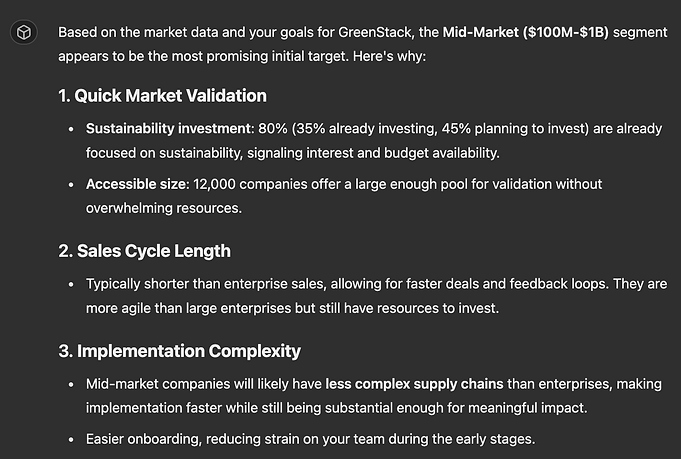
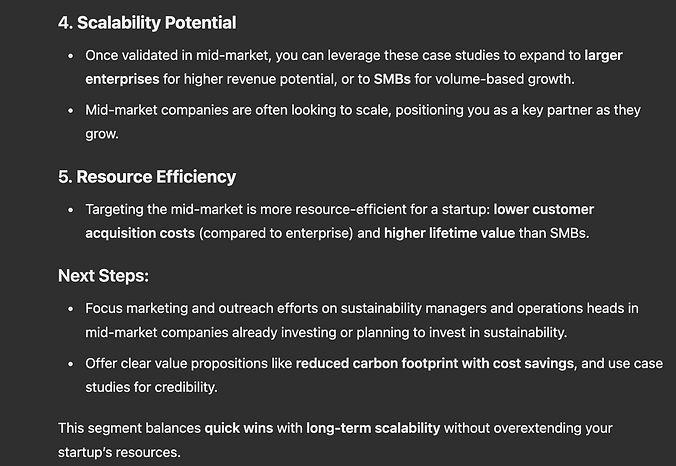
Sarah knows that trying to serve everyone is a recipe for failure. Let's see how she uses AI to identify her most promising market segment.
Step 1: Identifying target market segments
Why It's Important: With limited resources and runway, Sarah needs to find the perfect intersection of market readiness, capability fit, and growth potential.
How to Do It: Sarah starts by asking AI to analyze her market data and identify promising segments to target
Sarah's prompt to AI:
- Enterprise ($1B+): 150 companies, 200,000+ metric tons carbon footprint
- Mid-Market ($100M-$1B): 12,000 companies, 25,000-200,000 metric tons
- SMB ($1M-$100M): 200,000 companies, 1,000-25,000 metric tons
And these sustainability investment indicators:
- Already investing: 35%
- Planning to invest: 45%
- No immediate plans: 20%
Help me identify the most promising initial market segment for GreenStack.
Consider:
- Our limited resources as a startup
- Need for quick market validation
- Potential for expansion
- Sales cycle length
- Implementation complexity"
AI Response:
Step 2: Industry Vertical Analysis
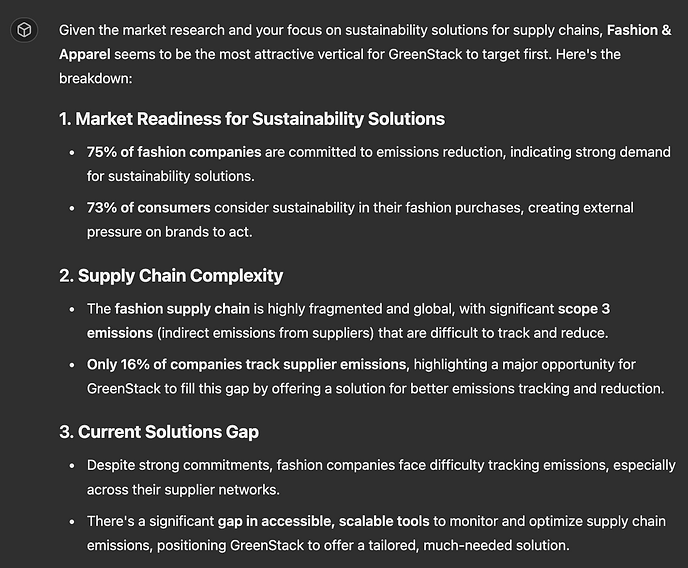
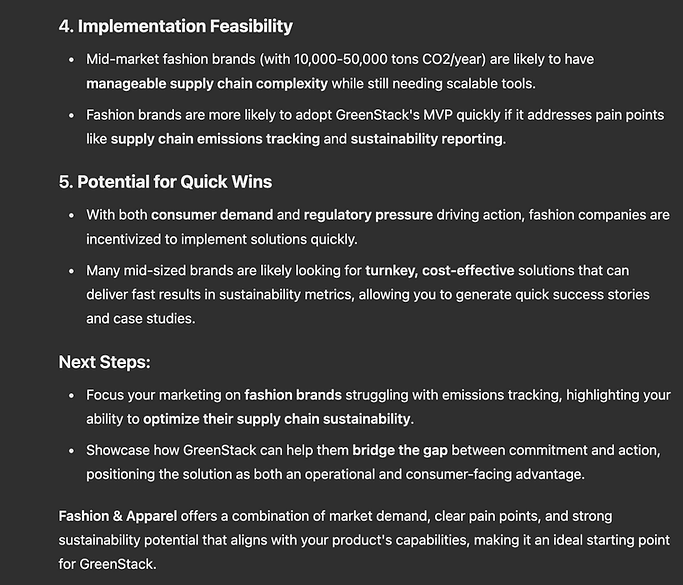
Why It's Important: Each industry vertical has different sustainability challenges, buying behaviors, and potential for impact.
How to Do It: Use AI to analyze the characteristics of each vertical to identify the best starting point.
Sarah's prompt to AI:
Market Size (from Statista 2023 & eMarketer):
- US e-commerce: ~$905B
- Major verticals by share:
- Electronics & Tech: 22% (~$199B)
- Fashion & Apparel: 19% (~$172B)
- Home & Furniture: 12% (~$109B)
- Beauty & Personal: 9% (~$81B)
- Sustainability Data (CDP & McKinsey 2023):
- 75% of fashion companies committed to emissions reduction
- Average mid-market fashion brand: 10,000-50,000 tons CO2/year
- 73% of consumers consider sustainability in purchases
- Only 16% of fashion companies track supplier emissions
Help me evaluate which vertical to target first, considering:
- Market readiness for sustainability solutions
- Supply chain complexity
- Current solutions gap
- Implementation feasibility
- Potential for quick wins
AI Response:
Sarah's follow-up prompt:
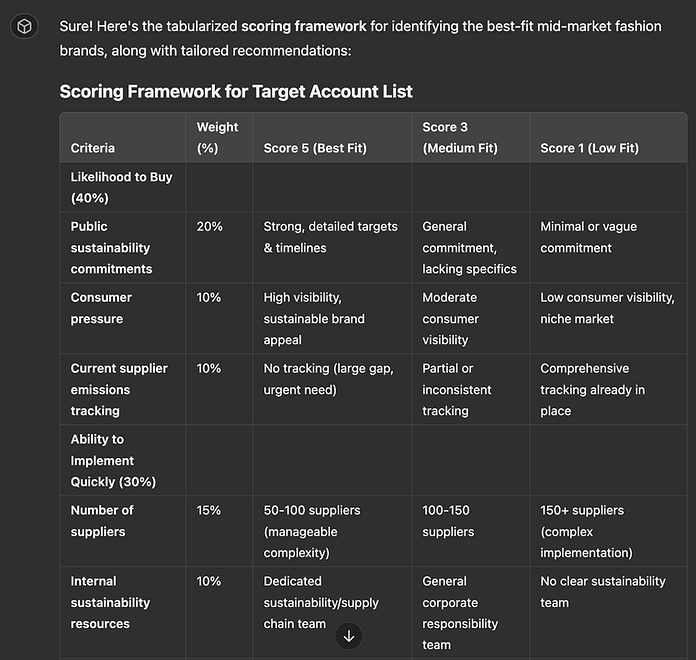
Using market data from Crunchbase and company ESG reports:
- 1,200 mid-market fashion brands
- 75% have public sustainability commitments
- 16% have supplier emissions tracking
- Average of 50-200 suppliers per brand
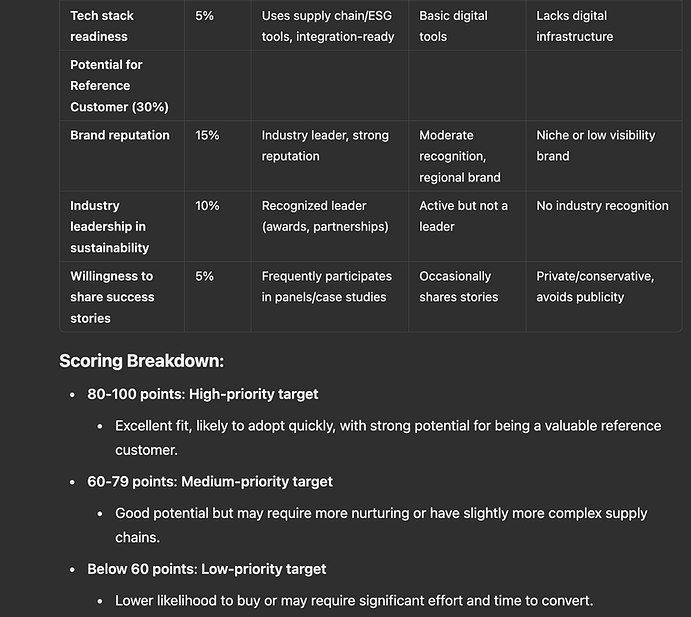
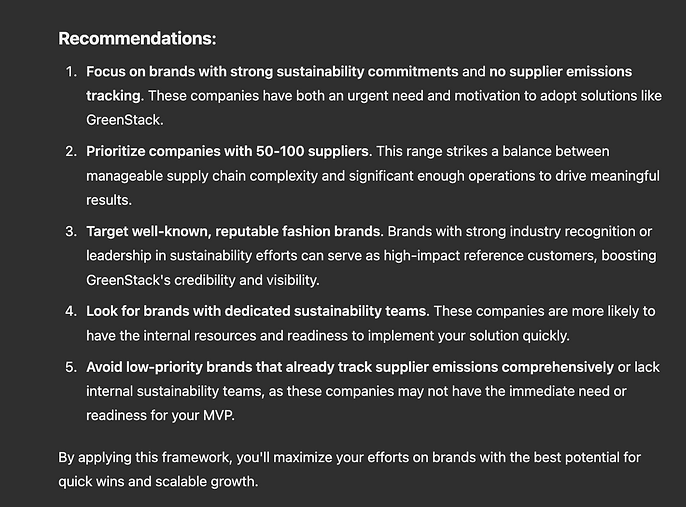
Create a scoring framework to identify best-fit companies based on:
- Likelihood to buy
- Ability to implement quickly
- Potential for reference customer
AI Response:
Competitive Strategy: Finding GreenStack's Edge
Step 1: Competitive Landscape Analysis
Why It's Important: Before positioning GreenStack, Sarah needs to understand the real gaps in the market and where established players are winning or struggling.
How to Do It: Map competitors and analyze their strengths, weaknesses, and target segments.
Sarah's Prompt:
Enterprise Supply Chain & Sustainability Platforms:
- SAP Sustainability Control Tower
- Full enterprise suite
- $300K-1M+ annually
- 9-12 month implementation
- Used by Nike, H&M Group
- Carbon Accounting Platforms (Series A/B funded):
- Watershed: $100K-300K annually
- Mainly enterprise focused
- Backed by Sequoia, Kleiner Perkins
- Used by Everlane, Warby Parker
- Persefoni: $50K-200K annually
- Strong in financial services
- $146.6M total funding
- SEC reporting focus
- Supply Chain Visibility Tools:
- TrusTrace: Started in fashion
- Material traceability focus
- €50-150K annually
- Used by Adidas, Asics
- TextileGenesis
- Fiber traceability platform
- Project-based pricing
- Industry partnership model
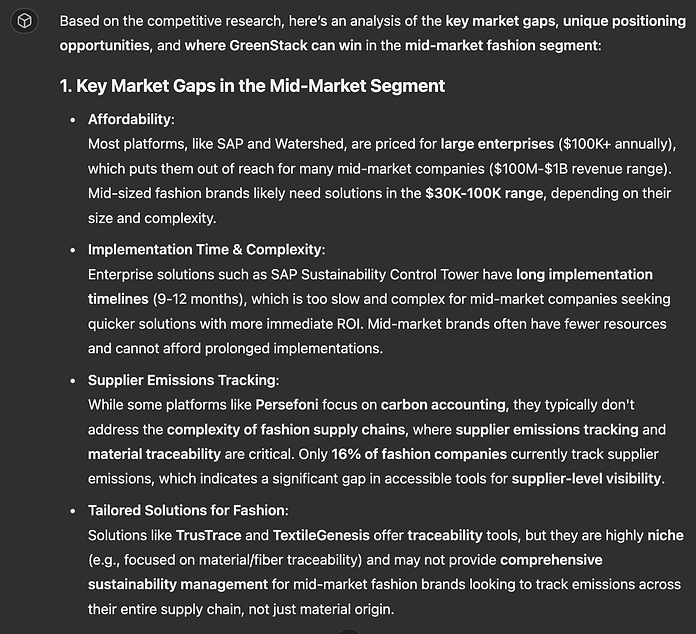
Help me identify:
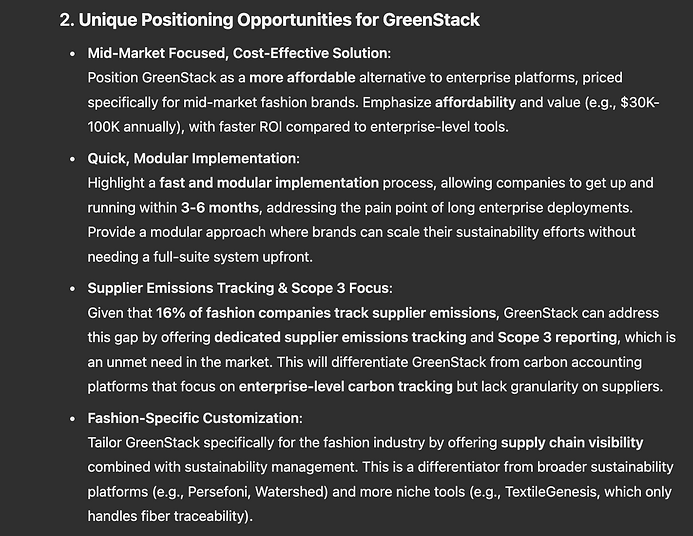
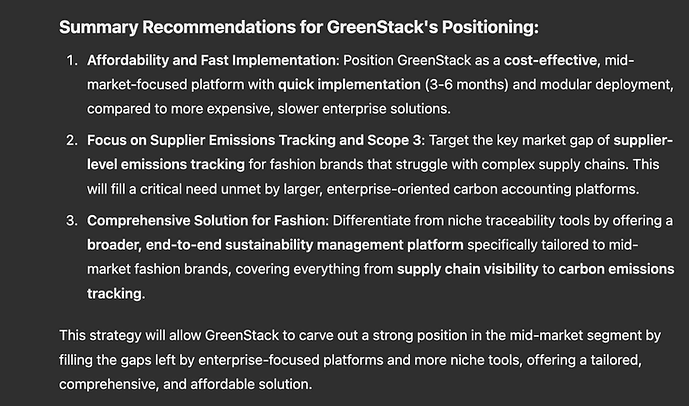
- Key market gaps in the mid-market segment
- Unique positioning opportunities
- Where GreenStack can win against each competitor type
AI Response:
Step 2: Positioning Development
Why It's Important: Sarah needs to clearly communicate GreenStack's unique value against these established players.
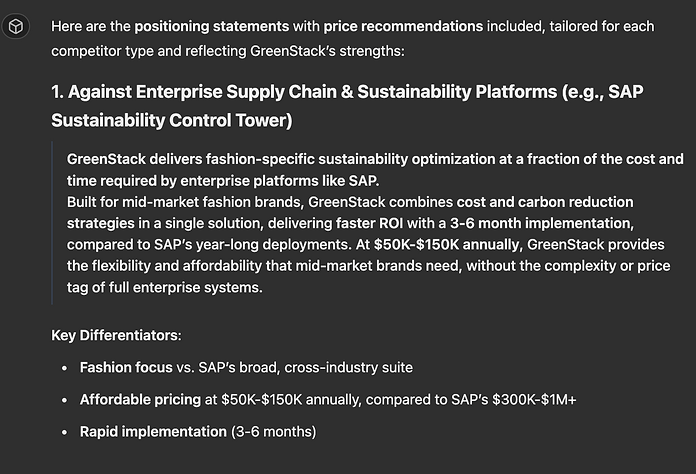
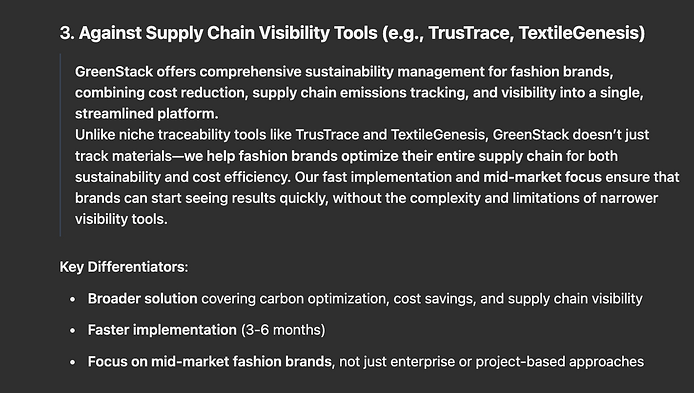
How to do it: With the market and sectors identified, develop positioning statements based on the arrived at target
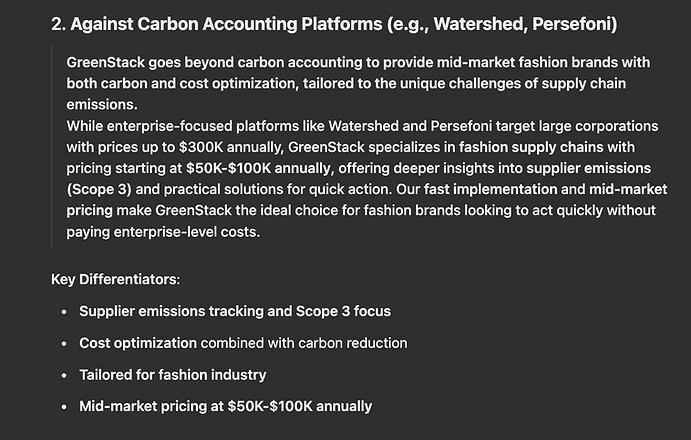
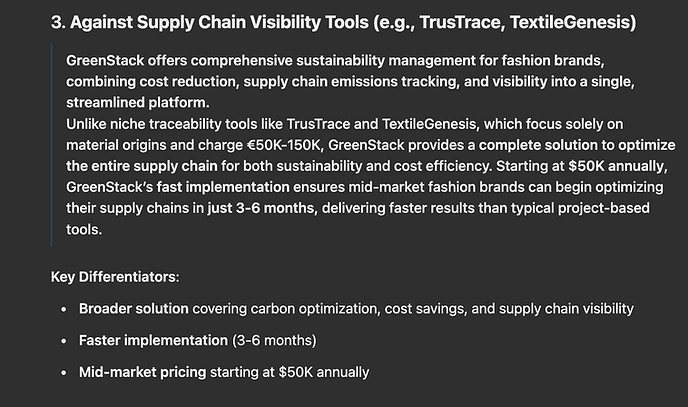
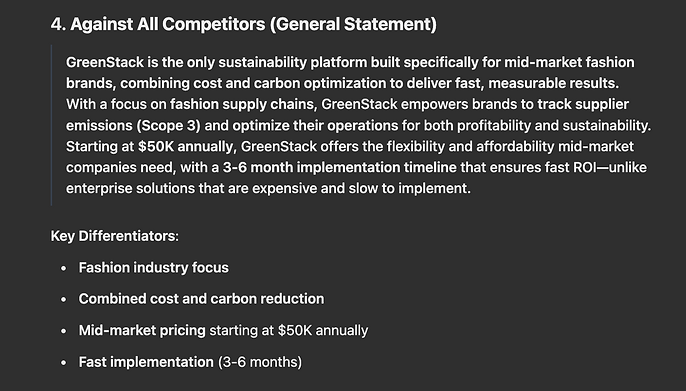
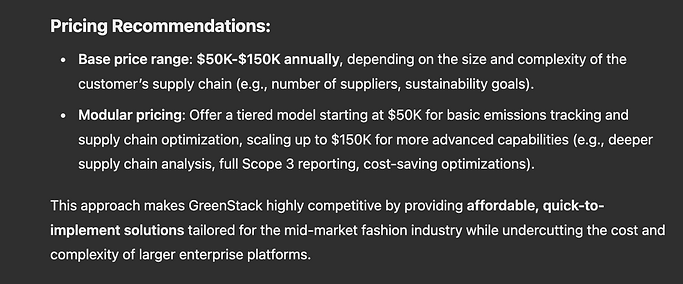
Sarah's Prompt:
- Fashion industry focus
- Combined cost & carbon optimization
- Fast implementation
- Mid-market sweet spot
AI Response:
Pro Tips:
- Break down complex GTM questions into specific, data-focused prompts (e.g., "Analyze market size" vs "Help me with GTM")
- Have AI analyze successful GTM examples in similar markets to identify patterns and strategies
- When using AI for market sizing, always ask it to show its calculation logic and assumptions
- Feed real competitor website content to AI for more accurate positioning analysis
- Use AI iteratively - start broad, then drill down with more specific prompts based on initial insights
Considerations:
- AI models might have outdated market data - always verify critical numbers with current sources
- Keep prompts focused on specific GTM components rather than asking for complete plans
- AI can help structure thinking but shouldn't make final strategic decisions
- AI excels at pattern recognition but might miss industry-specific nuances - combine with your expertise
- The quality of AI outputs depends heavily on the specificity and accuracy of your inputs
- *Continued in Part 2
Knowledge Check
1 / 5According to the guide, which of the following is NOT one of the five critical questions a solid Go-to-Market (GTM) plan answers?