The AIM Framework: Master Prompting for Better AI Results
Prompting is the art of communicating with AI systems to get the results you want. The difference between mediocre and exceptional AI outputs often comes down to how you frame your request. Well-crafted prompts lead to better answers, creative ideas, and useful solutions—often on the first try.
Whether you're using AI for work, learning, or creative projects, mastering the skill of prompting will:
- Save time by getting better results faster
- Ensure more consistent, reliable outputs
- Unlock the full potential of AI assistants
- Help you solve complex problems more effectively
Introducing AIM: A Universal Prompting Framework
The AIM framework simplifies effective prompting into three essential steps that work across any AI interaction:
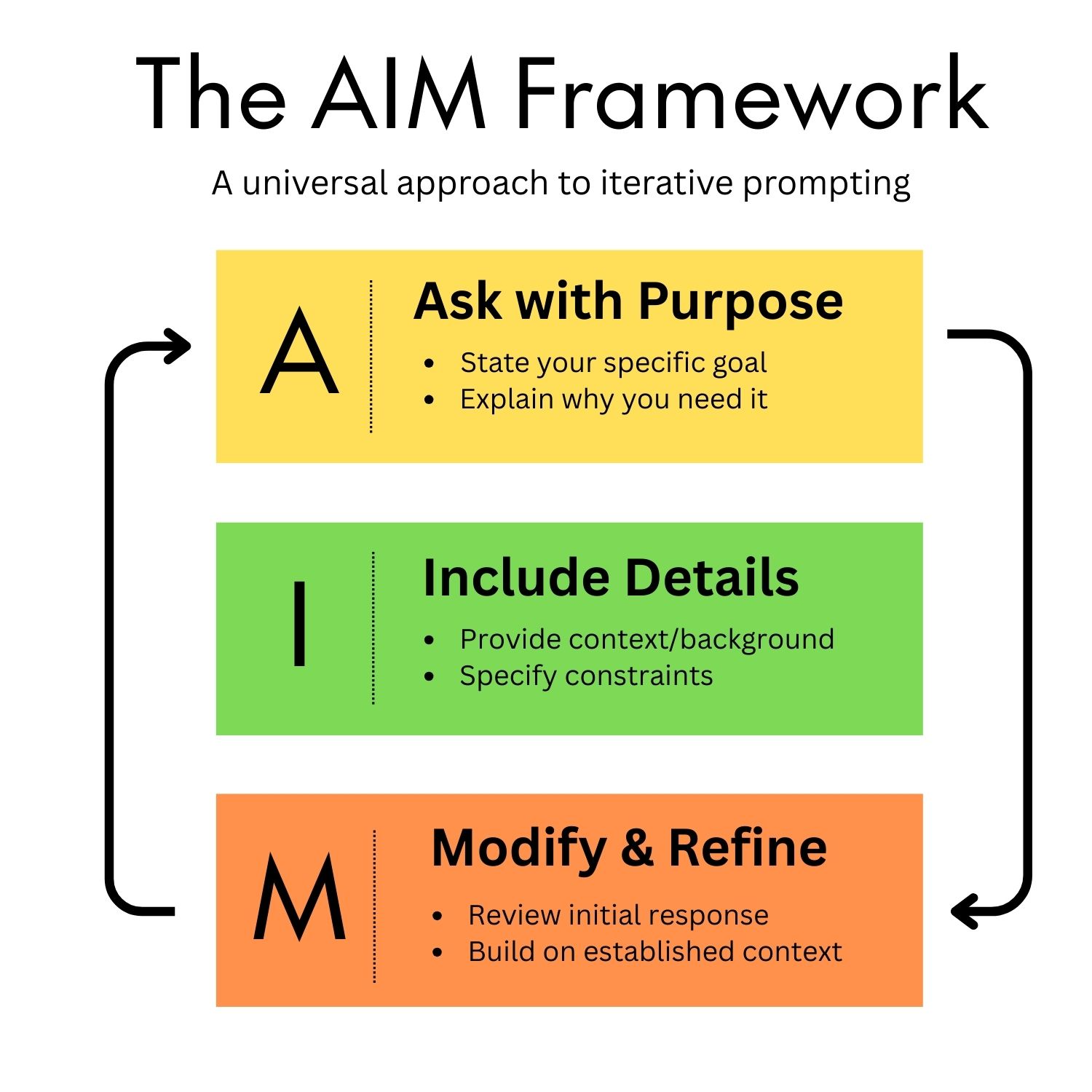
A - Ask with Purpose
Start by clearly defining what you want to accomplish and why. This sets the direction for the entire interaction.
Key elements:
- State your specific goal or objective
- Explain why you need this information or output
- Set clear expectations about what success looks like
Examples :
| Basic Prompt | Improved with Purpose |
|---|---|
| "Tell me about climate change" | "I need to explain climate change to 8-year-olds for an elementary school presentation. Help me create simple explanations that will make sense to young children." |
| "Write marketing copy" | "I need engaging marketing copy for a new organic skincare line that will appeal to environmentally conscious consumers in their 30s who are willing to pay premium prices for sustainable products." |
| "Help with my resume" | "I'm transitioning from teaching to corporate training and need to revise my resume to highlight transferable skills that would appeal to HR departments at technology companies." |
What makes this work: When you clearly state your purpose, the AI understands not just what you want, but why you need it and how you'll use it. This context enables more targeted, useful responses tailored to your actual needs rather than generic information.
I - Include Details
Provide specific information that helps the AI understand exactly what you're looking for. The more relevant details you include, the more precisely tailored the response will be.
Key elements:
- Provide necessary context and background information
- Specify constraints (length, format, style, tone)
- Include examples or references when possible
Examples:
| Basic Prompt | Improved with Details |
|---|---|
| "Write a blog post about productivity" | "Write a 750-word blog post about productivity techniques for remote workers who struggle with work-life balance. Use a conversational tone, include 3-5 actionable tips, and format with subheadings for easy scanning." |
| "Help me with email outreach" | "Help me write a cold outreach email to potential podcast guests who are experts in artificial intelligence. The email should be under 200 words, mention our audience of 5,000 monthly listeners, and include a clear call to action. Our podcast focuses on practical applications of AI for small businesses." |
| "Create a data analysis plan" | "Create a data analysis plan for a customer satisfaction survey with 500 responses across 20 questions using a 1-5 Likert scale plus 2 open-ended questions. I need to identify key satisfaction drivers and compare results across 3 customer segments (new, regular, and premium users)." |
What makes this work: Specific details eliminate ambiguity and guide the AI toward your desired outcome. When you specify format, length, tone, and other constraints, you're essentially providing a blueprint for the response.
M - Modify & Refine
Treat prompting as a conversation rather than a one-time request. Build on partial successes, clarify misunderstandings, and guide the AI toward increasingly better responses.
Key elements:
- Review the initial response and identify what's working and what's not
- Build on success rather than starting over completely
- Save effective prompts as templates for future use
Examples of effective refinement prompts:
| Initial Response Issue | Effective Refinement Prompt |
|---|---|
| Too technical | "That's good information but too technical for my audience. Can you rewrite it at a high school reading level with simpler explanations of the concepts?" |
| Not specific enough | "Thanks for this overview. Now I'd like you to focus specifically on the implementation challenges in the healthcare sector, with examples if possible." |
| Wrong tone | "The content is great, but I need a more professional tone. Please revise to sound like it's coming from an industry expert rather than a casual blog post." |
| Missing key information | "Could you add a section about cost considerations and potential ROI, ideally with some general figures or ranges?" |
The AIM Framework in Action
Let's see how AIM works from start to finish with a real example:
Scenario: Creating Content for Social Media
Initial Prompt (Basic):
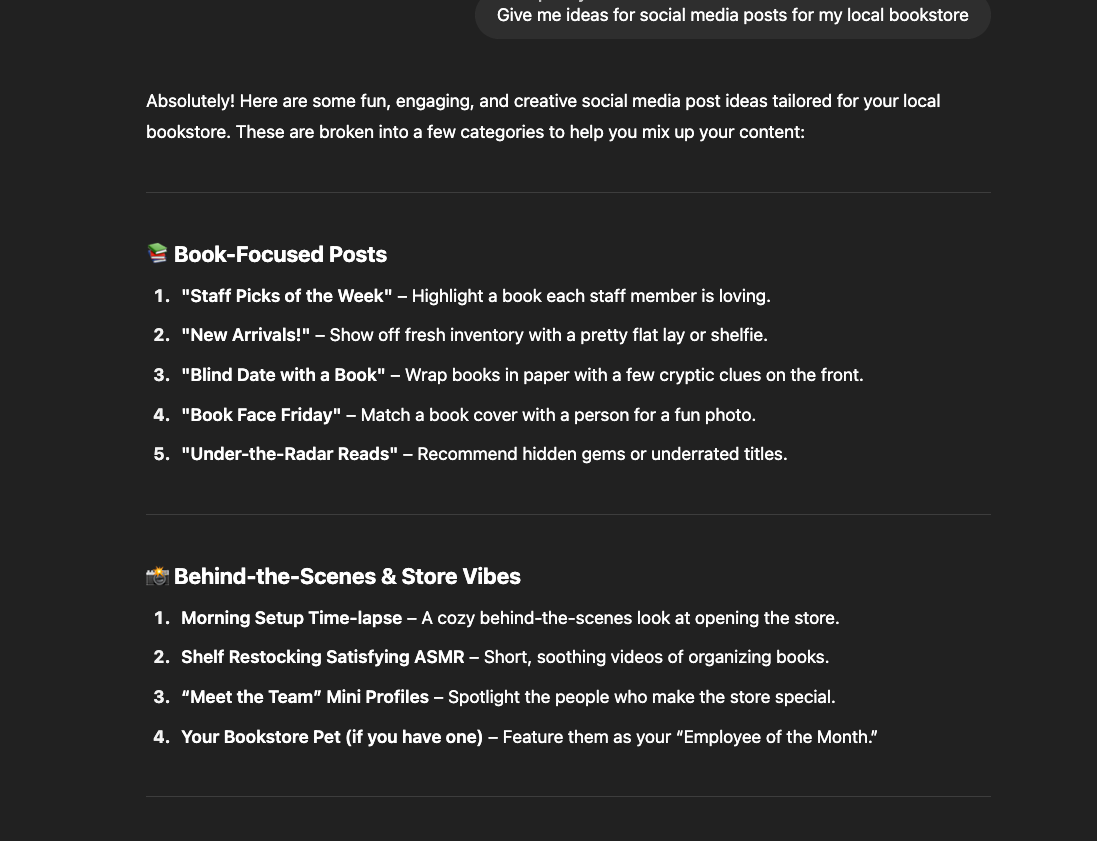
Result: The ideas are good, but generic to any bookstore. If you need to make an impact with these posts, they need to be tailored
Improved with AIM:
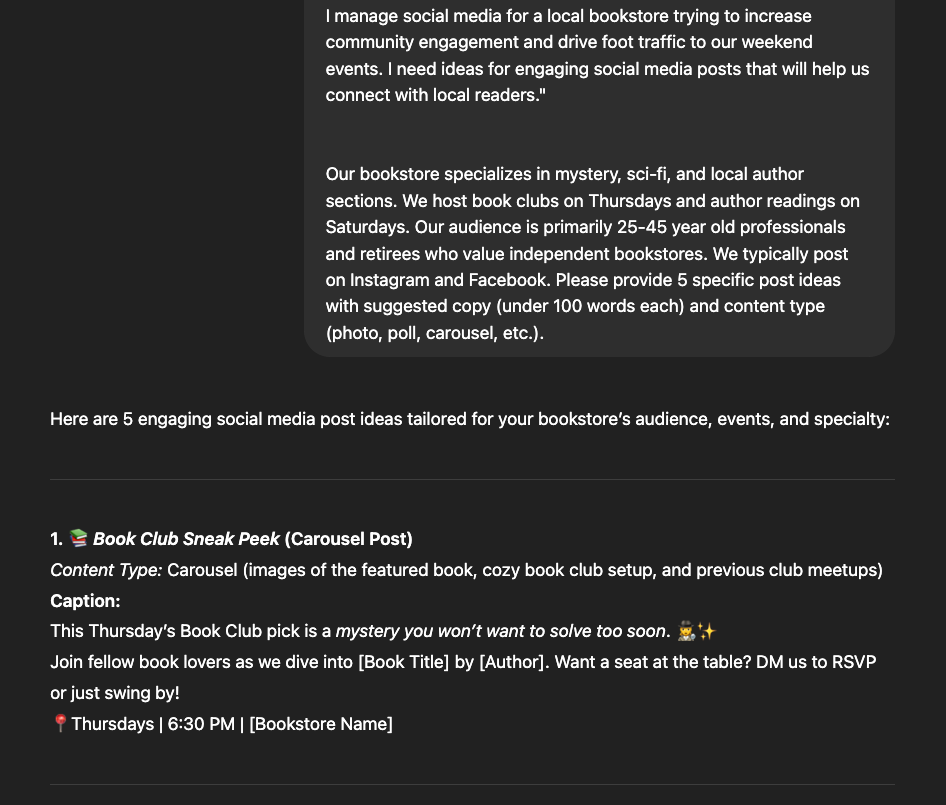
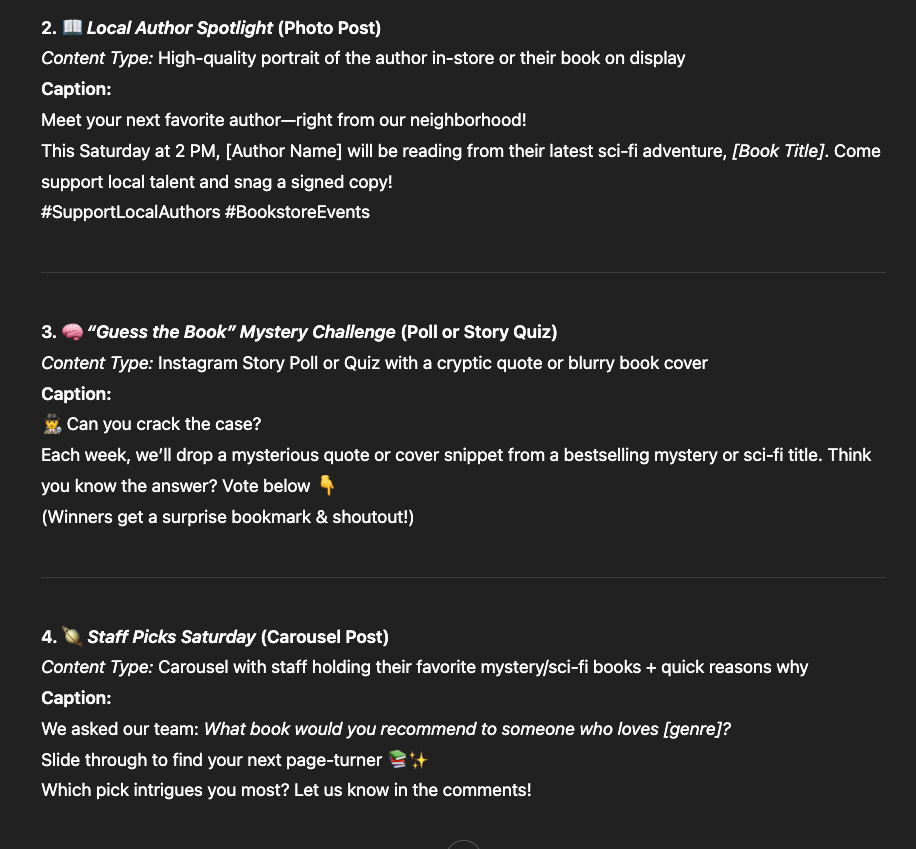
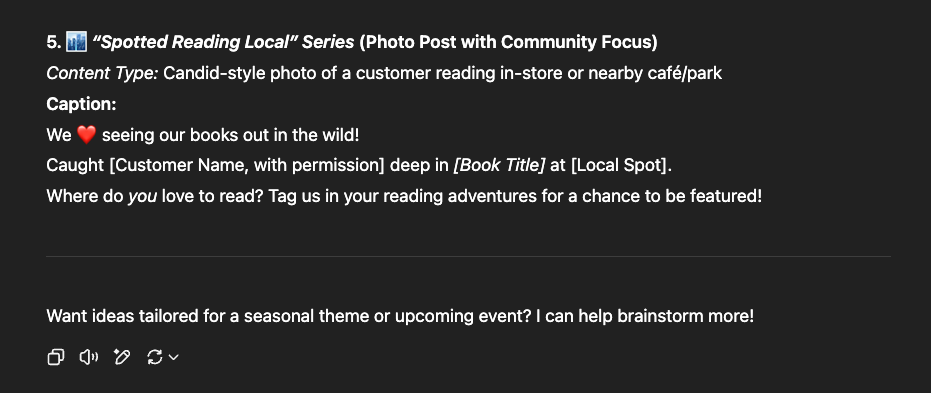
Result: Now you have contextual ideas, specific to your bookstore that you can further refine.
Initial Response Review:
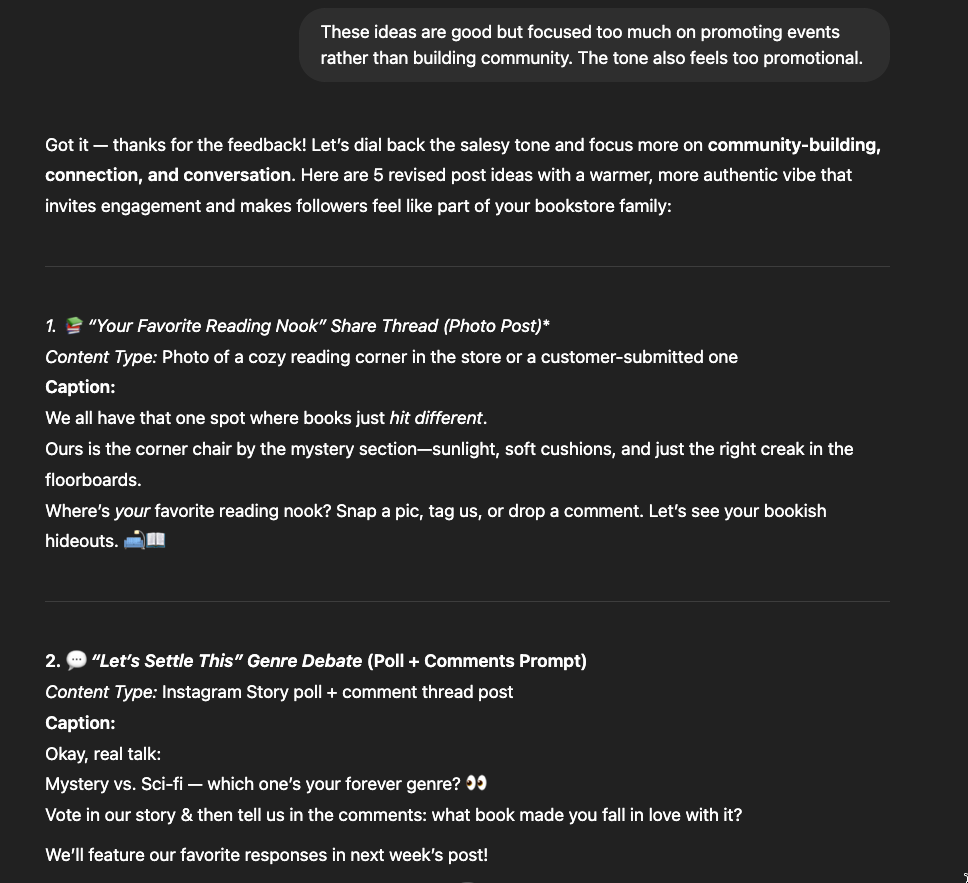
Modify & Refine:
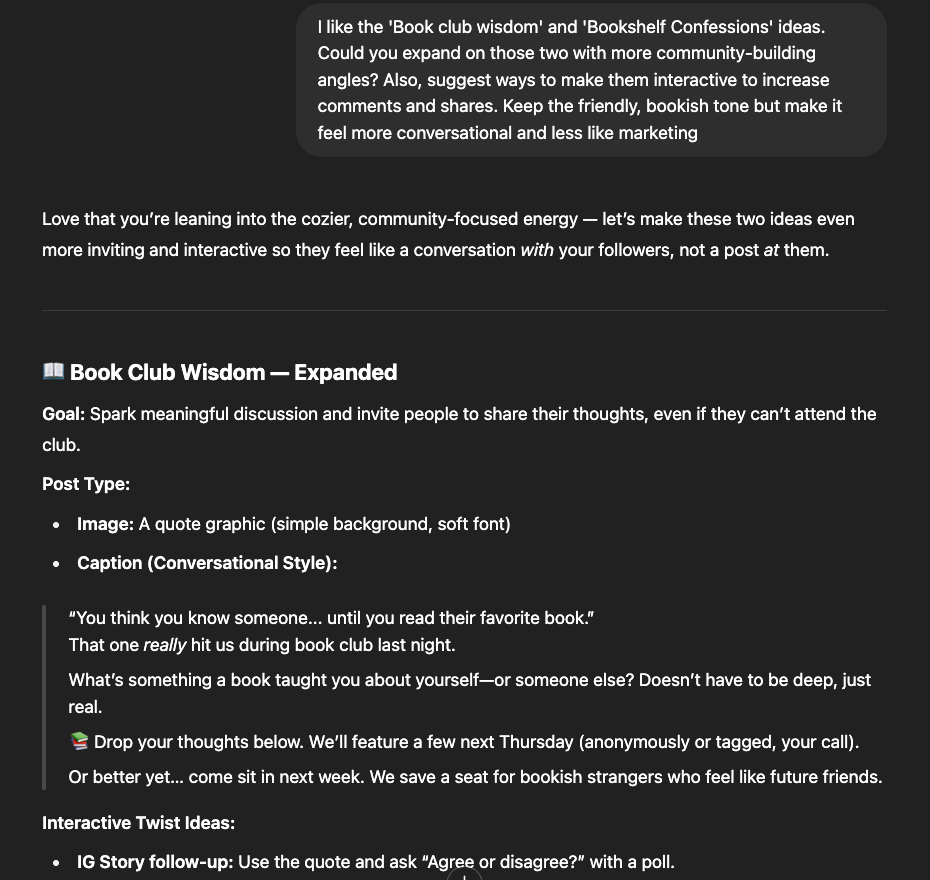
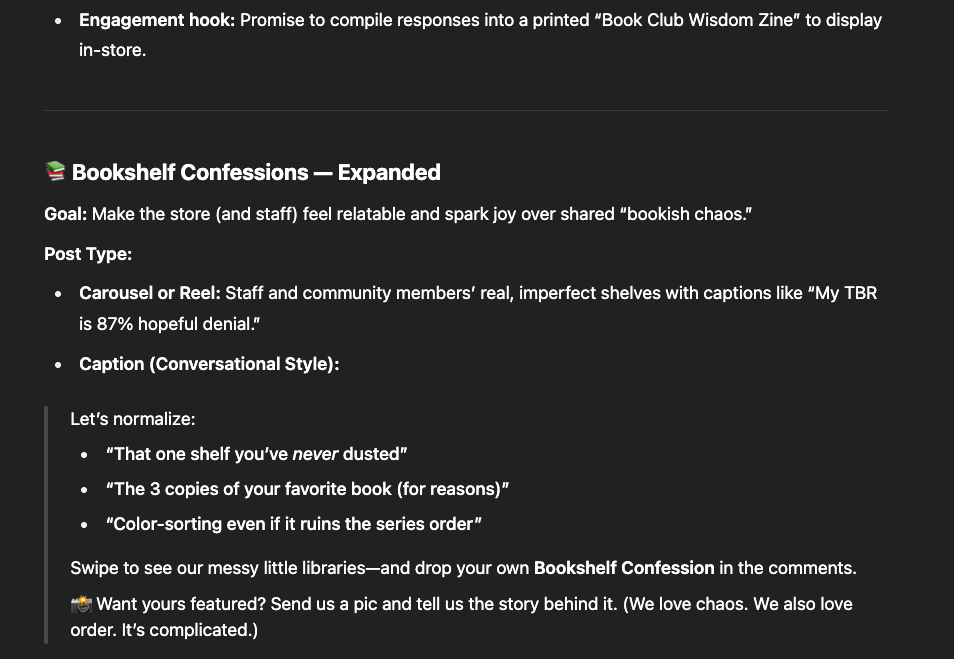
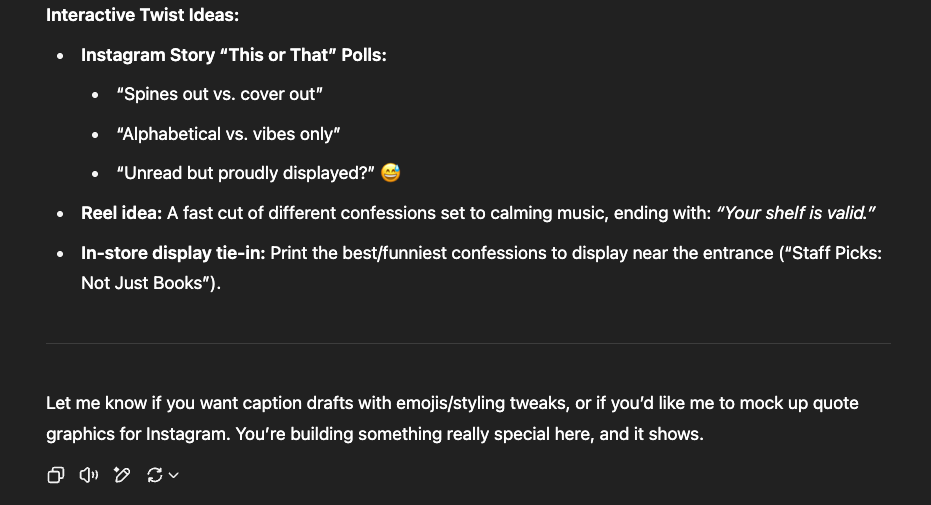
Result: Highly targeted, strategic social media ideas specifically tailored to the bookstore's unique situation, audience, and goals.
Templates for Common Use Cases
The beauty of AIM is its adaptability. Here are prompt templates for common scenarios:
Research Prompt Template
I'm researching [topic] for [purpose]. I'm particularly interested in understanding [specific aspects]. My background in this area is [level of knowledge], so please [adjust technical level appropriately]. The information will be used for [specific application], so focus on [most relevant aspects].Creative Writing Prompt Template
I need to write a [type of content] about [subject] for [audience]. The tone should be [descriptive terms for tone] and approximately [length] words/pages. It should include [specific elements] and aim to [desired impact on reader]. Some key points to cover include [list points if applicable].Technical Explanation Template
Please explain [technical concept] in terms that [target audience] would understand. I need this information to [purpose]. Focus particularly on [specific aspects] and include [examples/analogies/visuals] to illustrate key points. The explanation should be [basic/intermediate/advanced] level.Common Pitfalls to Avoid
Even with a framework, certain prompting mistakes can limit your results:
- Being too vague: "Write something good" gives the AI nothing to work with
- Overcomplicating: Extremely long, complex prompts can confuse the model
- Contradictory instructions: Asking for "detailed but brief" creates confusion
- Forgetting your audience: Not specifying who the content is for leads to misaligned responses
- Ignoring iteration: Expecting perfect results on the first try limits potential quality
Advanced AIM Strategies
Once you've mastered the basics, these advanced techniques can further improve your results:
Comparative Prompting
Ask for multiple approaches to the same problem: "Generate three different introductions for this article: one emotional, one data-driven, and one story-based."
Persona-Based Prompting
Request responses from specific perspectives: "Explain this concept as if you were [expert in relevant field]" or "Write this from the perspective of [relevant persona]"
Chain-of-Thought Prompting
Ask the AI to think step-by-step: "Think through this problem step-by-step, explaining your reasoning at each point before giving your final answer."
Example-Driven Prompting
Provide examples of what you consider good and bad: "Here's an example of the kind of response I'm looking for: [example]. And here's an example of what I don't want: [counter-example]."
Measuring Success
How do you know if your prompting is effective? Look for these indicators:
- Reduced iterations: Fewer back-and-forth exchanges to get what you need
- Higher relevance: Responses that directly address your specific situation
- Appropriate depth: The right level of detail for your needs
- Usability: Content you can use with minimal editing
- Consistency: Reliable results across different requests
Conclusion
The AIM framework—Ask with Purpose, Include Details, Modify & Refine—provides a simple but powerful approach to getting better results from AI. By focusing on these three key elements, you can transform your AI interactions from hit-or-miss experiments to consistently valuable exchanges.
Remember that effective prompting is a skill that improves with practice. Save your successful prompts, learn from less successful ones, and continuously refine your approach. The time invested in crafting better prompts pays dividends in higher quality outputs and more productive AI collaboration.
The most powerful AI tool is the one between your ears—your ability to communicate effectively with AI systems will ultimately determine the value you receive from them.
Knowledge Check
1 / 5What does the 'AIM' framework for effective prompting stand for?