Understanding Qubits and their role in Quantum Computers
At the heart of quantum computing lies the qubit—a fundamental unit of information that operates in ways unlike anything found in classical computing. While traditional computers rely on bits that exist as either a 0 or a 1, qubits can exist in multiple states at once, thanks to the principles of quantum mechanics. This ability unlocks computational power far beyond what classical systems can achieve.
But how do qubits work? Why are they so powerful? And what makes them so difficult to build and control? This guide breaks down the fascinating world of qubits, explaining their unique properties, how they function, and why they hold the key to the future of computing.
What You’ll Learn
- What a qubit is and how it differs from a classical bit
- The core principles of qubits: superposition, entanglement, and interference
- The different types of qubits and how they are created
- The challenges of building stable qubits
- The future of qubit development and quantum computing
Qubits vs. Classical Bits: What’s the Difference?
To understand why qubits are revolutionary, let’s first look at classical bits. In a classical computer, everything is encoded using bits—tiny switches that can be either 0 or 1. This binary system powers everything from smartphones to supercomputers by processing long strings of 0s and 1s in complex sequences.
Qubits, however, work differently. Instead of being limited to just 0 or 1, a qubit can exist in a superposition of both states at the same time. This allows quantum computers to explore multiple possibilities simultaneously, giving them an exponential edge in solving certain types of problems.
A Simple Example: Classical vs. Quantum
Imagine you are trying to find the correct path through a giant maze.
- A classical computer would try each path one by one, checking whether it leads to the exit. This takes time, as it must explore every possibility sequentially.
- A quantum computer with qubits in superposition, on the other hand, can explore all possible paths at the same time, dramatically speeding up the process.
This ability to process multiple possibilities at once is what makes qubits so powerful.
The Key Principles of Qubits
Qubits don’t just store information differently—they behave according to the bizarre rules of quantum mechanics. Three core principles define their power:
1. Superposition: Existing in Multiple States at Once
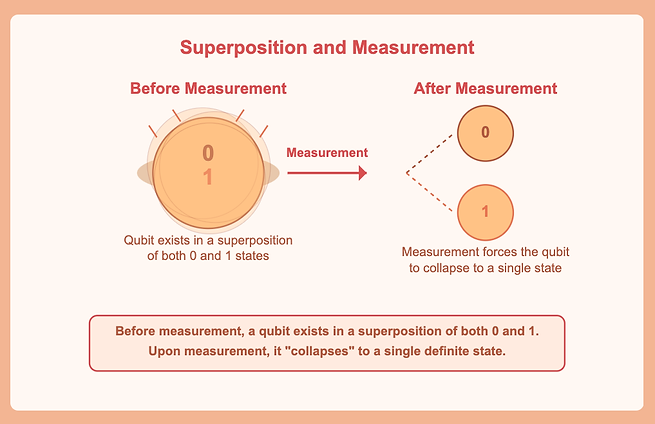
Superposition is what allows a qubit to be both 0 and 1 simultaneously. Until it is measured, a qubit exists in a blend of states, like a spinning coin that hasn’t landed on heads or tails yet.
Think about making a big decision, like choosing where to go on vacation. If you’re using a classical computer, it’s like considering one option at a time—Paris or Tokyo, one after the other. But a qubit works like keeping both options open at once, evaluating them simultaneously. This is why quantum computers can process vast amounts of information much faster than classical computers, which have to work step by step.
2. Entanglement: The Quantum Connection
Entanglement is a mysterious quantum effect where two qubits become linked, meaning the state of one instantly determines the state of the other, no matter how far apart they are.
Imagine you and your best friend each have a pair of gloves. If you both randomly grab one without looking and run miles apart, the moment you check your glove and see it’s the left one, you immediately know your friend has the right one. But unlike gloves, entangled qubits don’t just “match up”—they are fundamentally connected in a way that even Einstein called “spooky action at a distance.” This connection enables quantum computers to perform incredibly fast and complex computations that classical computers struggle with.
3. Quantum Interference: Steering Computations Toward the Right Answer
Quantum interference allows quantum computers to amplify the correct answers while canceling out incorrect ones. This is crucial for making quantum computations useful.
Think of it like ripples in a pond. If you throw two stones close together, the waves they create will interfere—sometimes adding up to make bigger waves, and sometimes canceling each other out. Quantum interference works in a similar way to help guide a quantum computer toward the best solution. Instead of randomly guessing answers, quantum computers use interference to enhance the right paths and suppress the wrong ones, making their calculations more efficient and accurate.
Different Types of Qubits: How Are They Made?
Creating qubits isn’t easy. Scientists and engineers are exploring different ways to build them, each with unique advantages and challenges. Here are the most common types, how they work, and the hardware they require:
- Superconducting Qubits – These are made using tiny electrical circuits that behave quantum mechanically at extremely low temperatures. Used by IBM and Google, they are among the most developed qubits today and are ideal for general-purpose quantum computing. They require dilution refrigerators to cool them to near absolute zero and are controlled using microwave pulses.
- Trapped Ion Qubits – These use single atoms suspended in electromagnetic fields and manipulated with lasers. They offer high accuracy and long coherence times, making them promising for high-precision quantum simulations and computations. This setup requires ultra-high vacuum chambers, electromagnetic traps, and highly stable laser systems.
- Photon-Based Qubits – These qubits are made from particles of light (photons) and are primarily used for quantum communication and secure data transmission, as they allow information to be transmitted over long distances without being easily intercepted. The hardware consists of optical components like beam splitters, phase shifters, and single-photon detectors.
- Topological Qubits – This theoretical approach encodes information in unique quantum states that make them more resistant to errors. Microsoft is exploring this technology, which could lead to more stable and fault-tolerant quantum computers. These qubits require specialized materials engineered to create topological quantum states, a field still in experimental stages.
Each approach has its strengths and weaknesses, and researchers are still exploring the best path forward.
The Future of Qubits and Quantum Computing
While we are still in the early days of quantum computing, rapid advancements are being made. Companies like IBM, Google, and Microsoft are scaling up the number of qubits they can control, while researchers are developing better error correction methods to make quantum computations more reliable.
Looking ahead, quantum computers could revolutionize fields such as cryptography, artificial intelligence, drug discovery, and complex simulations. As scientists continue to refine qubit technology, we may soon reach the point where quantum computers can solve real-world problems that are impossible for classical computers to handle.
However, challenges remain. Scaling quantum systems to thousands or even millions of qubits will require breakthroughs in hardware stability, error correction, and manufacturing processes. Governments and private institutions are investing heavily in quantum research, recognizing its potential to reshape industries and scientific discovery.
One of the most promising developments is the concept of hybrid computing—where classical and quantum computers work together. Instead of replacing traditional systems, quantum computers will likely complement them, tackling problems that classical systems struggle with while offloading other tasks to classical architectures.
The road to practical quantum computing is long, but every breakthrough in qubit development brings us closer to a future where quantum machines unlock new frontiers in science and technology. The race is on, and the next decade could determine how—and when—quantum computers become a transformative force in the world.
Qubits are the foundation of this revolution, and understanding them is the first step toward grasping the immense potential of quantum computing. As technology advances, who knows? The quantum breakthroughs of tomorrow might come from the curious minds of today.