Using AI for financial analysis and projections
In today's fast-paced business environment, leveraging AI for financial analysis and planning can provide companies with a significant competitive edge. AI-powered tools can process vast amounts of financial data quickly, generate insightful visualizations, create dynamic financial models, and analyze various scenarios to support informed decision-making.
This guide will walk you through the process of using AI for comprehensive financial analysis and planning, using a real-world scenario to illustrate each step.
Real-World Scenario
Meet Sarah, the CFO of TechGrow Solutions, a medium-sized software development company that has been in business for 7 years. TechGrow has experienced steady growth but faces challenges in accurately forecasting future performance and making strategic financial decisions. Sarah needs to prepare a comprehensive financial analysis and plan for the upcoming board meeting, where critical decisions about expansion and investment will be made.
YoY Financial data :
| Year | Revenue | COGS | Gross Profit | Operating Expenses | Net Income | Cash Flow |
| 2017 | $5,000,000 | $3,000,000 | $2,000,000 | $1,500,000 | $500,000 | $750,000 |
| 2018 | $5,500,000 | $3,300,000 | $2,200,000 | $1,650,000 | $550,000 | $825,000 |
| 2019 | $6,050,000 | $3,630,000 | $2,420,000 | $1,815,000 | $605,000 | $907,500 |
| 2020 | $6,655,000 | $3,993,000 | $2,662,000 | $1,996,500 | $665,500 | $998,250 |
| 2021 | $7,320,500 | $4,392,300 | $2,928,200 | $2,196,150 | $732,050 | $1,098,075 |
| 2022 | $8,052,550 | $4,831,530 | $3,221,020 | $2,415,765 | $805,255 | $1,207,882 |
| 2023 | $8,857,805 | $5,314,683 | $3,543,122 | $2,657,341 | $885,780 | $1,328,671 |
YTD Financial data :
| Month | Revenue | COGS | Gross profit | Operating Expenses | Net Income | Cash flow |
| Jan 2024 | $800,000 | $480,000 | $320,000 | $240,000 | $80,000 | $120,000 |
| Feb 2024 | $820,000 | $492,000 | $328,000 | $246,000 | $82,000 | $123,000 |
| Mar 2024 | $840,000 | $504,000 | $336,000 | $252,000 | $84,000 | $126,000 |
| Apr 2024 | $860,000 | $516,000 | $344,000 | $258,000 | $86,000 | $129,000 |
| May 2024 | $880,000 | $528,000 | $352,000 | $264,000 | $88,000 | $132,000 |
| Jun 2024 | $900,000 | $540,000 | $360,000 | $270,000 | $90,000 | $135,000 |
Step 1: Define Your Objective
Sarah's prompt to AI:
AI's response:
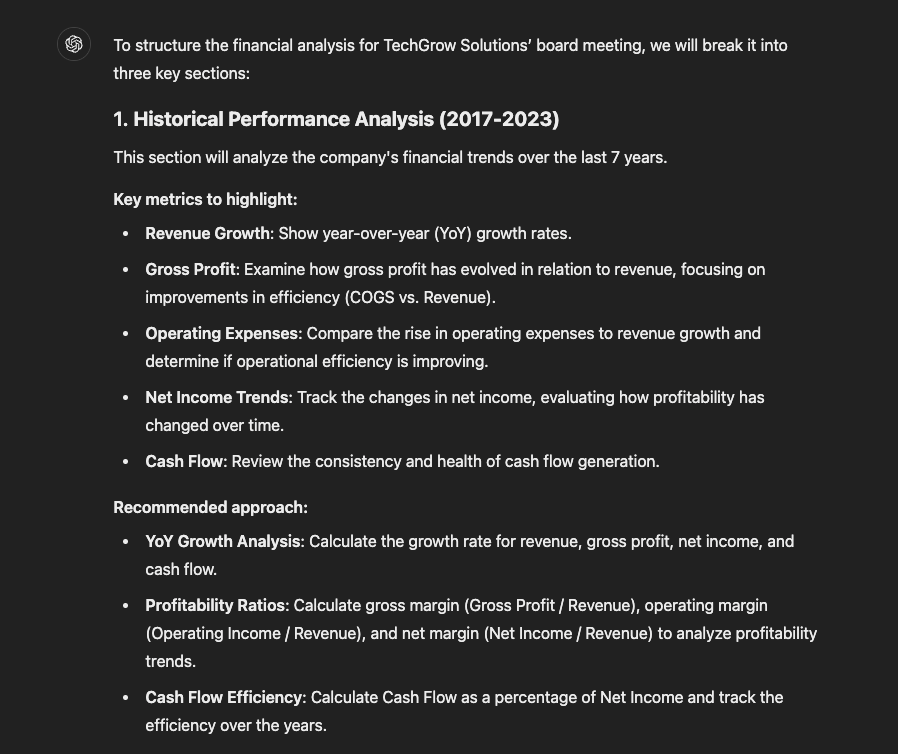
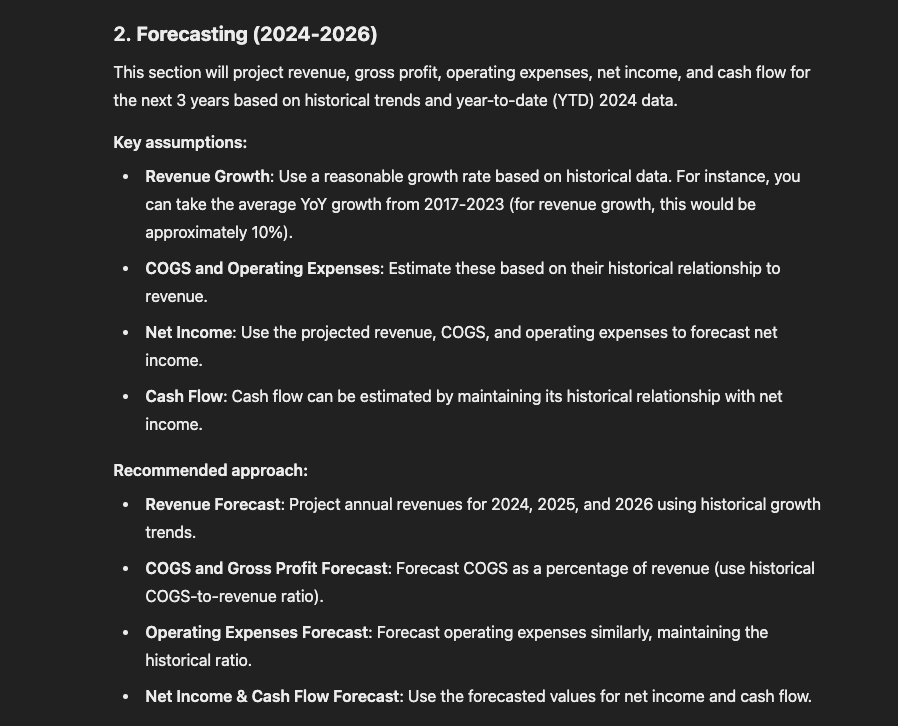
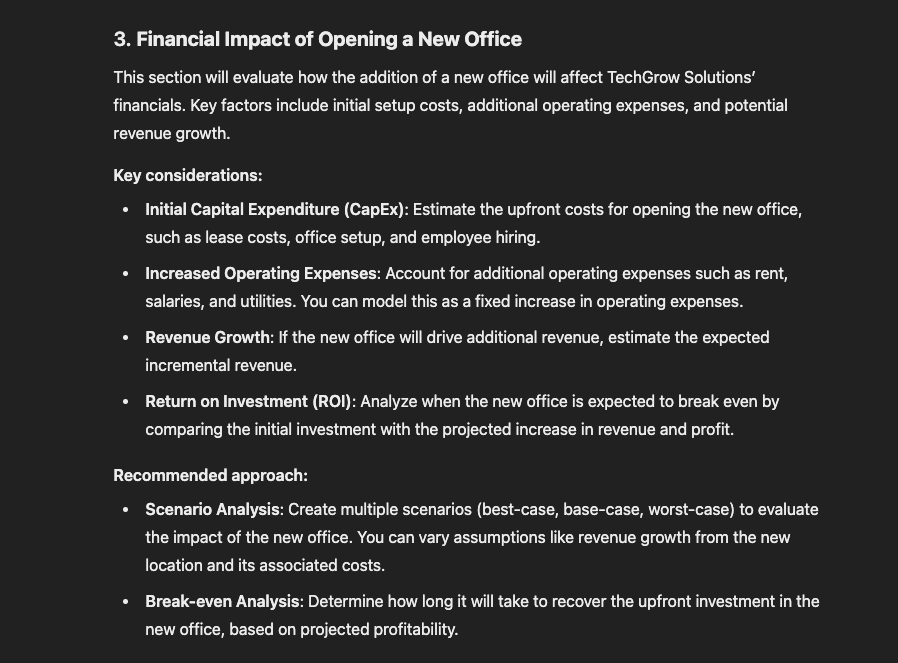
This structure provides Sarah a process to analyze the data and approach her goal.
Step 2: Preparing Financial Data for Analysis
Sarah's prompt to AI:
AI's response:
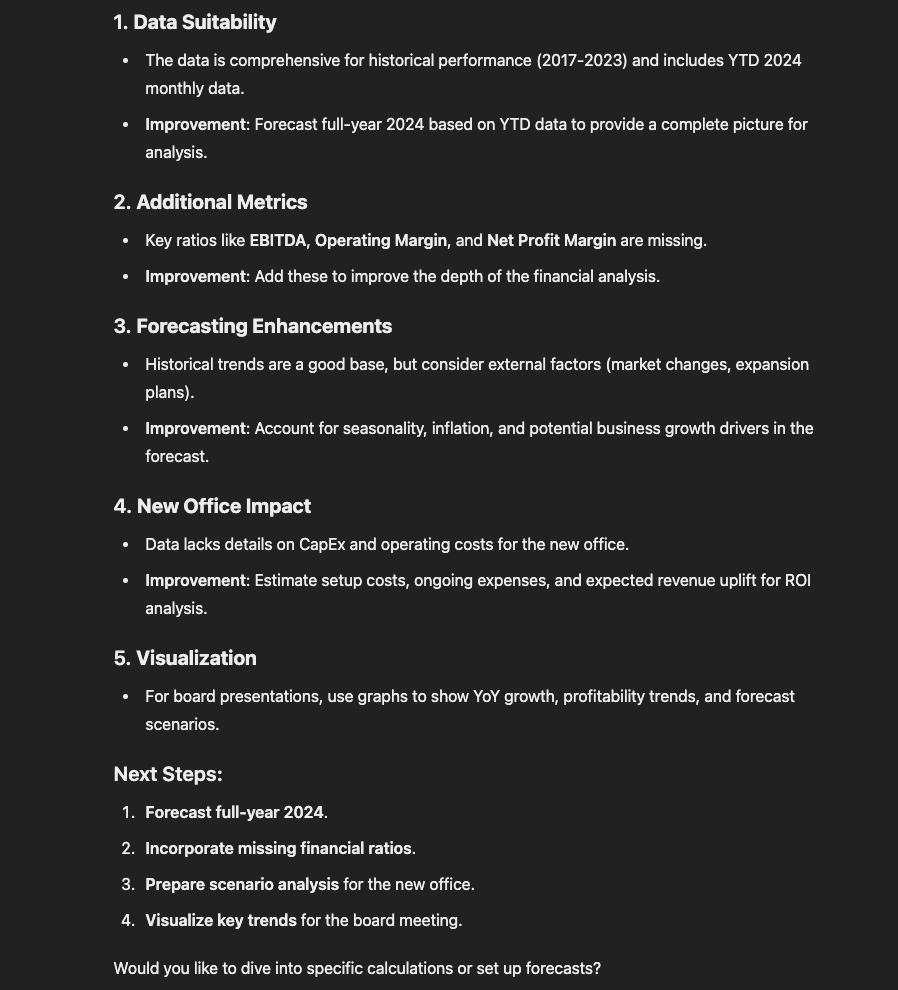
The AI provides insights on how the data can be enhanced for better insights and analysis.
Step 3: Generating Interactive Visuals and Insights
Sarah's prompt to AI:
AI's response:
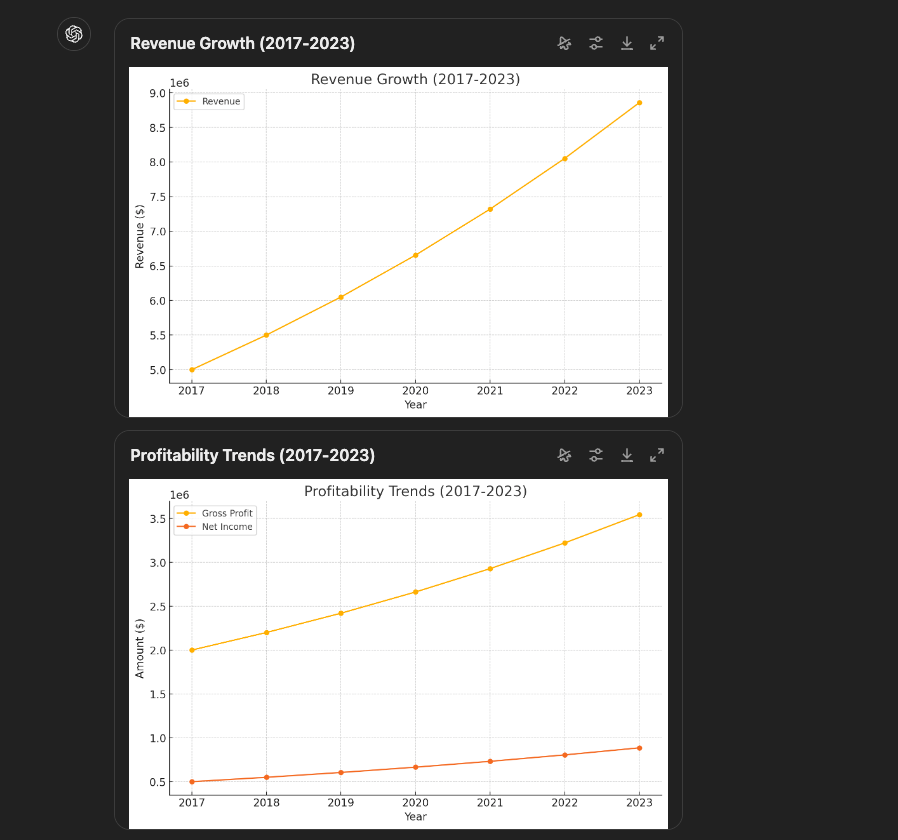
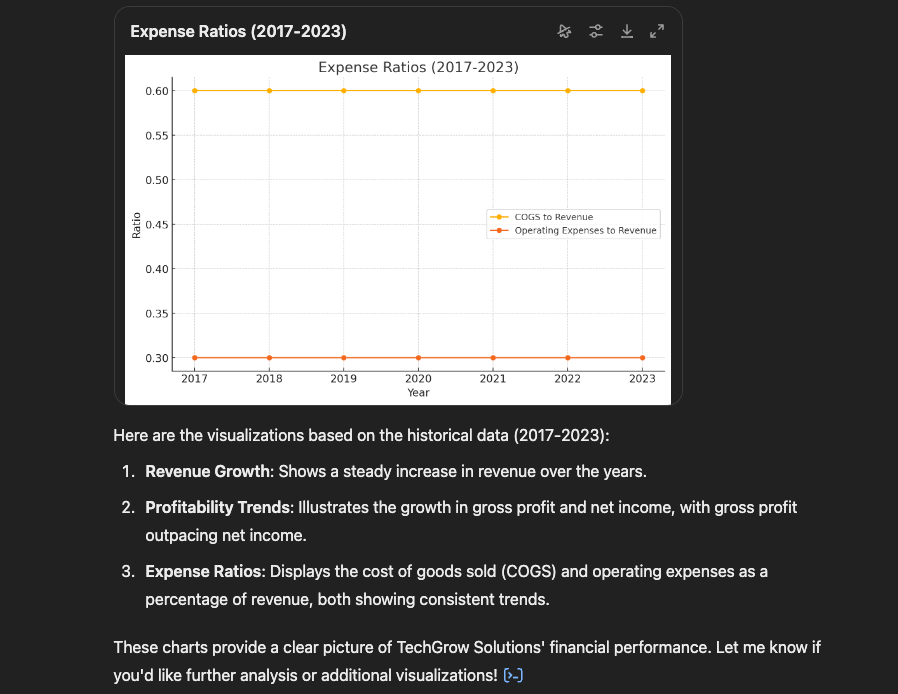
These visualizations highlight TechGrow's consistent growth and gradual improvement in profitability.
Step 4: Dynamic Financial Modeling and Projections
Sarah's prompt to AI:
AI's response:
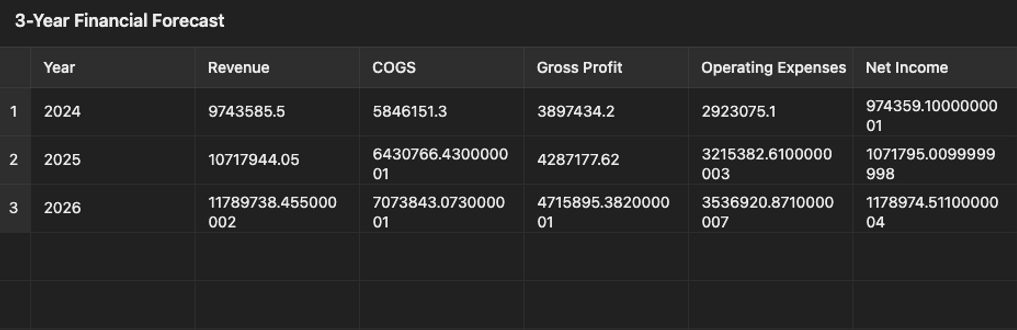

Step 5: Simulating Different Financial Scenarios
Sarah's prompt to AI:
AI's response:
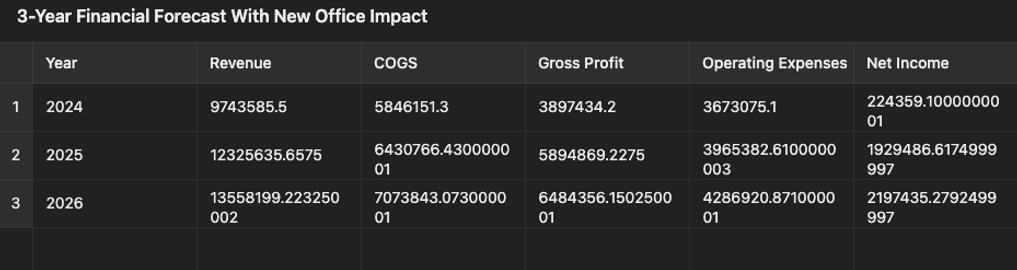
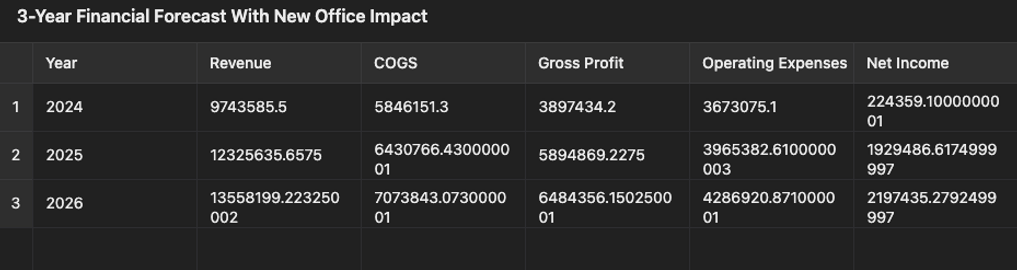
This analysis suggests profitability might be flat with the new office, but it could lead to substantial growth in the medium term.
Pro Tips
- Clearly define your objectives and assumptions before starting the analysis.
- Regularly update and clean your financial data to ensure accurate AI-driven insights.
- Use AI to generate multiple scenarios and stress-test your financial models.
- Combine AI-generated insights with human expertise for optimal decision-making.
Considerations
- Always verify AI-generated insights against your industry knowledge and experience.
- Be aware of potential biases in historical data that may affect future projections.
- Consider external factors (market trends, economic conditions) that may not be captured in internal financial data.
- Ensure data security and confidentiality when using AI tools for financial analysis.
- Regularly audit and validate AI models to maintain accuracy and reliability.
Wrapping Up
The journey through TechGrow Solutions' case study demonstrates the transformative potential of AI in financial analysis and planning. By leveraging AI effectively, organizations can transform raw data into actionable insights, simulate and test multiple scenarios as well as, generate visuals on their data.
As you begin implementing AI in your financial analysis processes, start with clear objectives, focus on data quality, and gradually expand your use of AI tools as your confidence grows. The future of financial analysis lies not in replacing human judgment but in enhancing it with AI's powerful analytical capabilities.
Knowledge Check
1 / 5What is a primary advantage of leveraging AI for financial analysis and planning, as stated in the guide?